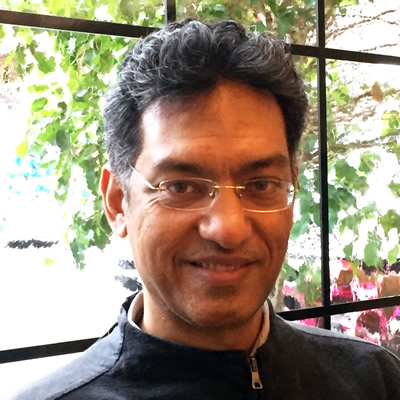
Viren Murthy
Faculty Director
Department of History
4108 Humanities
455 N Park St
Madison, WI 53706
Faculty Webpage
Biography
My work probes the historical conditions for the possibility of philosophy and politics in the modern world and in East Asia in particular. I am generally interested in the attempts of East Asian intellectuals to resist modernity through reviving premodern philosophies and religions, such as Buddhism. My first book, The Political Philosophy of Zhang Taiyan: The Resistance of Consciousness, shows how in early 20th century China, Zhang Taiyan, drew on Consciousness-Only (Yogācāra) Buddhism to formulate a theory of revolution. In particular, the book explains how this seemingly ancient body of knowledge is reformulated as China was incorporated into the global capitalist system of nation-states.
In June 2022, I published The Politics of Time in China and Japan: Back to the Future (Routledge), which is a collection of essays that explore how Chinese and Japanese intellectuals mobilize traditional texts to create a better future. They produce what I call “back to the future” narratives, in which they conjure the past to envision a world beyond global capitalism. These narratives are nationalistic but unlike in England and the United States, this nationalism is connected to anti-imperialism and resistance to global inequality. I suggest that such inequality also divides Europe, which enables comparisons between Germany and Asian nations, all of whom saw themselves as being marginalized.
My third monograph Pan-Asianism and Legacy of the Chinese Revolution (University of Chicago Press, 2023) shows how intellectuals in China and Japan promoted unity among weak Asian nations to resist Western domination. To promote such unity, pan-Asianists struggled against Eurocentric visions of history articulated by philosophers such as Hegel, who argued that the Orient had to follow the West. At the same time, these thinkers appropriated Hegel’s criticisms of abstract individualism. I contend that Japanese and Chinese pan-Asianists drew on elements of both Asian and Western culture to posit a world beyond narrow self-interest, capitalism, and imperialism. The legacy of pan-Asianism is complex given that Japan employed this ideology to promote imperialism. Consequently, postwar Japanese pan-Asianists had to confront the problem of war memory. Postwar pan-Asianists tried to show that a healthy transnationalism was both possible and necessary to struggle against Western imperialism.
My present project concerns how East Asian intellectuals drew on G.W.F Hegel to uncover logics to Chinese and Japanese history, which culminate in a new world order inspired by their respective cultures. In addition to the above projects connected to East Asia, I am also involved in a project on South Indian Classical Music and Tamil Identity, which also explores issues of how traditions have been reconstituted by capitalist modernity. I have also been interested in how Marxists in (primarily in the North Atlantic) have drawn on Jewish Messianism to confront capitalist modernity.